
 By Ghulam Mustafa Khan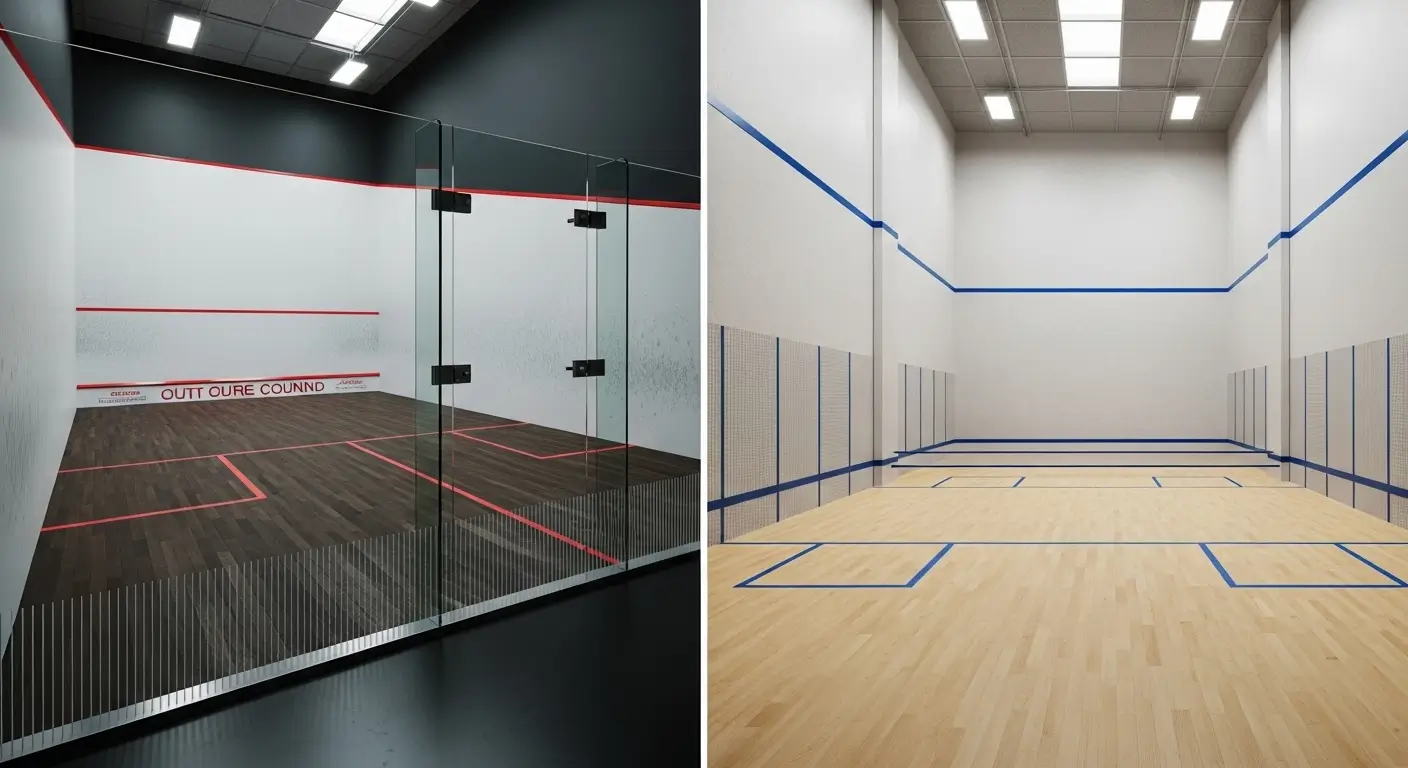
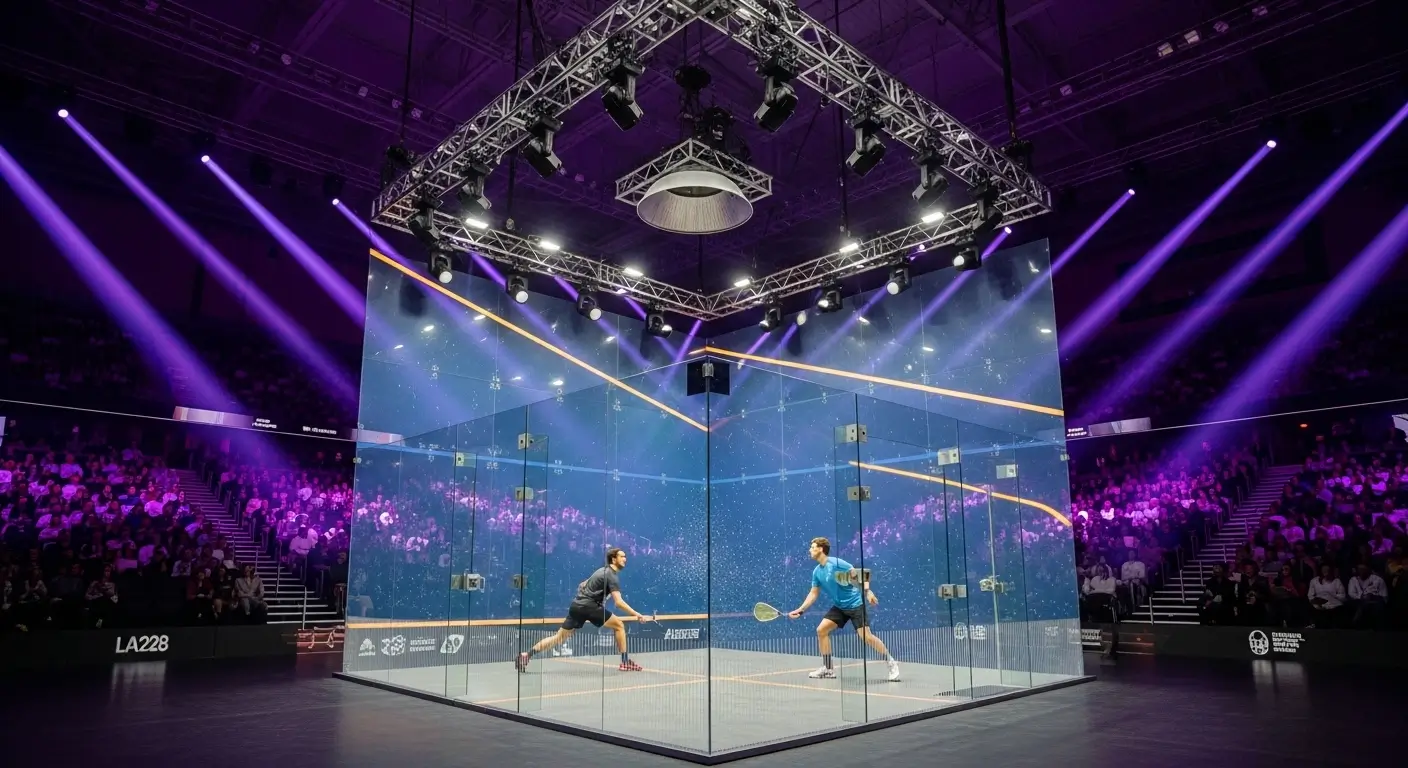
Choosing between a Squash Court vs Racquetball Court in 2026 is a major engineering decision. With Squash officially joining the LA28 Olympic Sports Program, homeowners and facility managers are looking closely at their existing spaces. Many athletes ask: Are squash and racquetball courts the same? While they both feature four walls, the structural physics and kinetic response of the surfaces are different. Understanding these details is critical for anyone looking to build a training environment or maximize property ROI with a home court.
Squash vs Racquetball Court Size: The Geometry Gap
The most immediate difference in a squash vs racquetball court comparison is the footprint. A racquetball court is a long narrow hallway. A squash court is shorter, wider, and features a specialized out of bounds zone at the bottom of the front wall.
Technical Specifications Table (2026 Data)
| Feature | Squash Court | Racquetball Court | Impact on Play |
| Length | 32 foot (9.75m) | 40 foot (12.19m) | RC requires linear sprinting. |
| Width | 21 foot (6.4m) | 20 foot (6.1m) | Squash demands lateral lunging. |
| Ceiling Height | 18.5 foot (5.64m) | 20 foot (6.1m) | RC uses the ceiling for lobs. |
| In Play Surface | Front, Side, Back | Front, Side, Back, Ceiling | Squash ceiling hits are out. |
| The Tin | 19 inch Metal Strip | None (Play to floor) | The Tin acts as a net. |
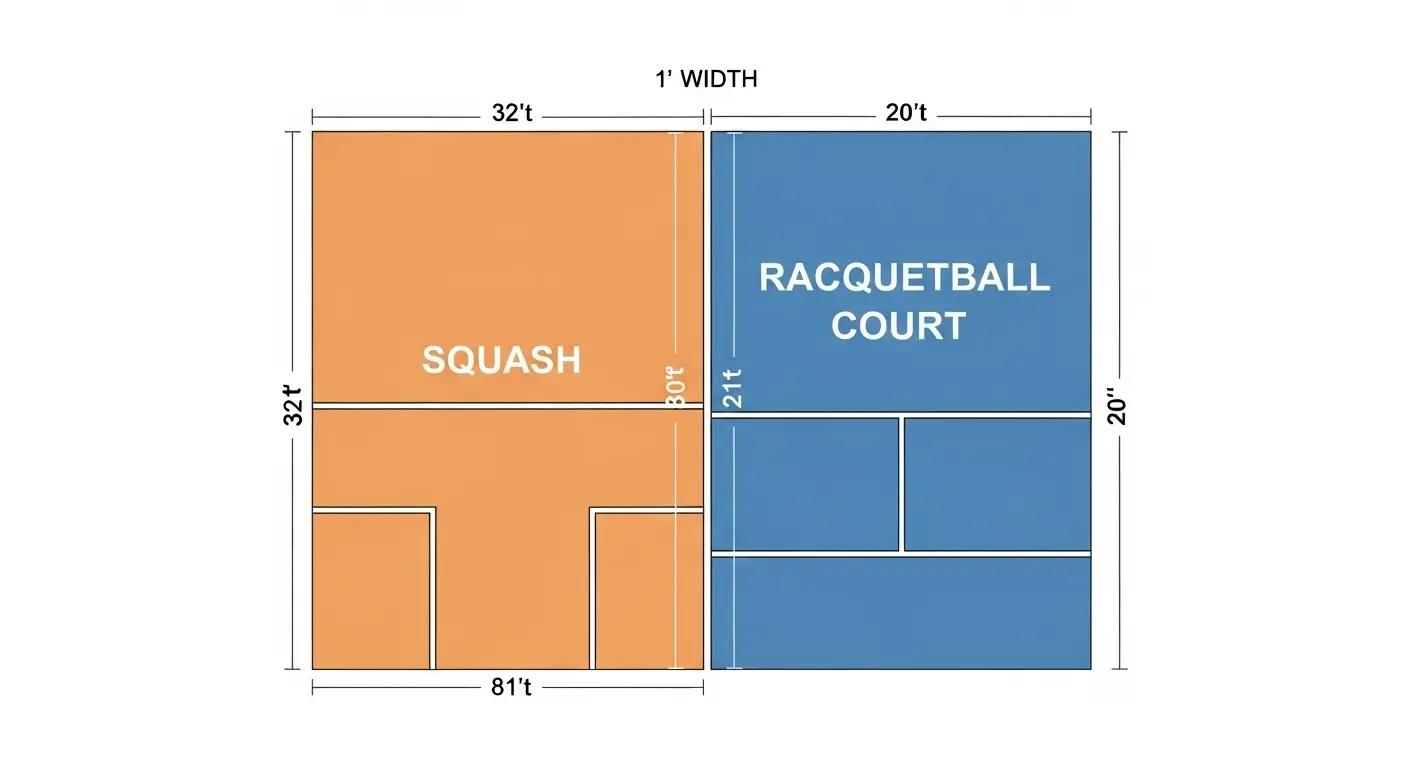
Expert Insight: A common mistake in home court design is ignoring the width trap. Because a squash court is 1 foot wider than a racquetball court, converting a racquetball room into a professional squash space often requires a structural wall adjustment to meet World Squash Federation technical tolerances.
Racquetball Court Dimensions in Meters: A Global Perspective
For international builders, the racquetball court dimensions in meters (12.19m x 6.1m x 6.1m) represent a massive volume of air. This height is mandatory because a professional racquetball can reach speeds of 191 mph. This speed requires a 20 foot ceiling in play rule for lob serves and overhead pinches.
The squash vs racquetball court size debate highlights that squash (9.75m x 6.4m x 5.64m) is more compact but requires a dead bounce wall finish to manage the low pressure squash ball. If you are building for the future, you must decide if the room can handle these ballistics.
The Eye Experience: Visual Depth and Perception
When you step into a squash vs racquetball court, your eyes have to adjust to two different visual horizons.
The Eye Experience Quote: “In a racquetball court, your eyes are trained on a massive 20 foot vertical plane. The ceiling is your friend. But in a squash court, your vision is forced downward toward the Tin. This creates a tunnel vision effect that makes squash feel much faster and more claustrophobic, even though the court is wider. If your lighting is not at least 500 Lux, you will lose the ball trajectory in the corners.” : Senior Court Consultant, 2026.
2026 Pro Tip: The Glare Audit
Just as you should perform a shadow audit for a professional basketball hoop for driveway placement, indoor courts require a glare audit. In 2026, LED panels must be recessed into the ceiling to prevent ghosting. This is the phenomenon where the ball disappears for a millisecond as it passes under a bright light source.
The Ballistic Reality: Can You Play Racquetball on a Squash Court?
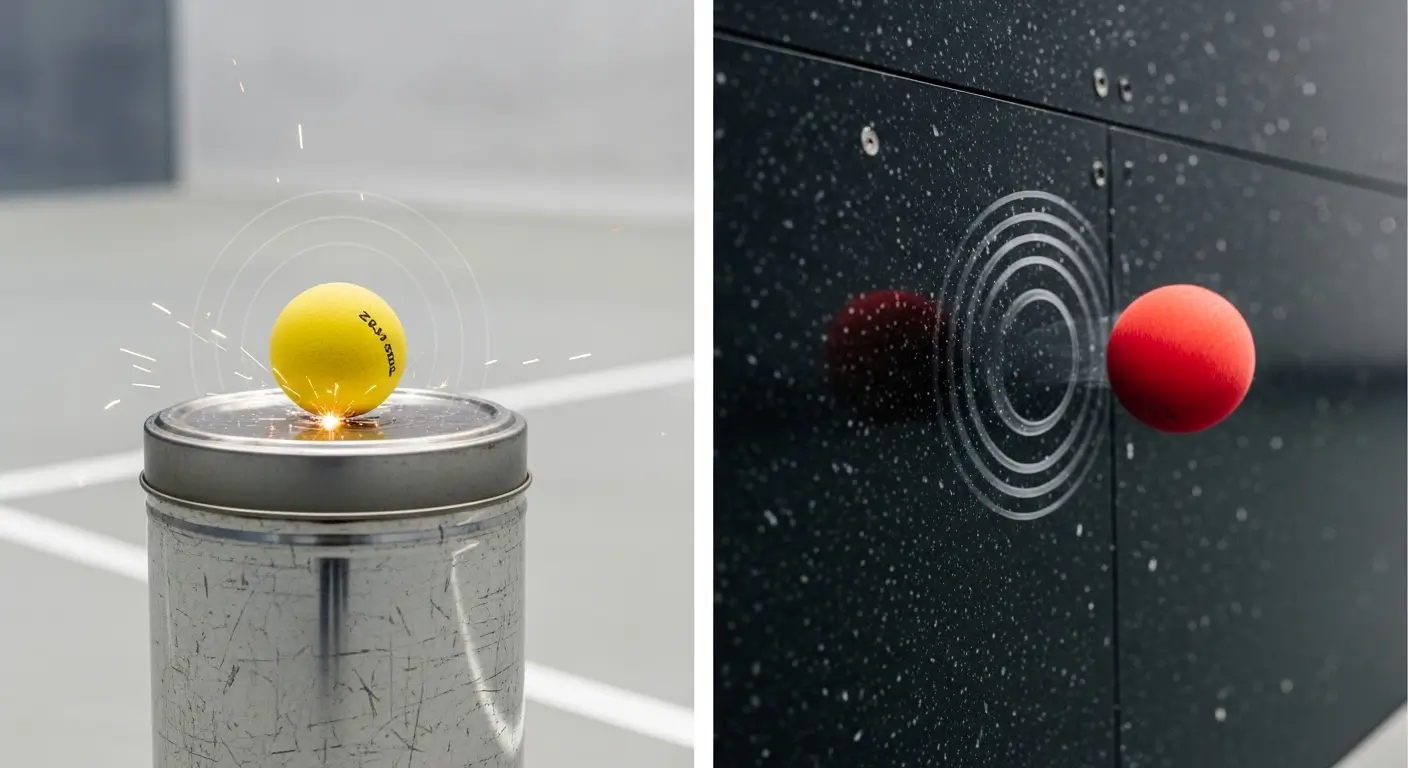
The most common question regarding a squash court vs racquetball court setup is whether the equipment is interchangeable. While you can physically swing a racket in either room, the physics of the ball creates a massive performance gap. A professional racquetball is a high pressure, 2.25 inch rubber sphere that stays live for a long period. In contrast, a squash ball is a low pressure thermal sphere that requires constant high velocity impact to stay warm and bouncy.
If you attempt to play racquetball on a squash court, the 32 foot length creates a dangerous environment. Because a racquetball travels at nearly 190 mph, the ball returns to the player too quickly for a safe swing.
The 20 foot ceiling in a standard racquetball room is a tactical necessity. When you move that game to an 18.5 foot squash court, you lose the ability to play lob serves or ceiling pinch shots. These are the core strategic elements of the sport.
The Great Velocity Gap: 191 MPH vs. The 19 Inch Tin
The squash vs racquetball court debate is ultimately a battle of the floor versus the Tin. In racquetball, the goal is to hit the ball as low as possible to the floor to create a kill shot. There is no lower boundary on the front wall. This is why a racquetball court feels like a vertical playground.
In squash, the 19 inch metal strip at the bottom of the front wall acts as a net. This is known as the Tin. If the ball hits this metal strip, the point is over. This single structural difference changes the entire biomechanical approach to the game. Squash players must lift the ball, while racquetball players try to roll it off the floor.
Performance Breakdown: Kinetic Response and Ballistics
| Metric | Squash Court | Racquetball Court |
| Ball Velocity | 100 to 170 mph | 150 to 191 mph |
| Bounce Height | Low (Needs heat) | High (Instant) |
| Wall Impact | Absorptive (Dead) | Reflective (Live) |
| Torsional Stress | Moderate | High (Structural) |
The Hybrid Solution: Squash 57 and Multi-Sport Conversions
In 2026, many facilities are solving the squash court vs racquetball court size dilemma by adopting Squash 57. This discipline uses a larger, 57mm ball that is less bouncy than a traditional racquetball, specifically designed to be played on a squash court footprint. This hybrid approach eliminates the danger of high-speed rebounds in a shorter room while maintaining the explosive nature of racket sports.
If your goal is to build a multi-sport indoor room, you should prioritize the larger racquetball footprint. It is structurally easier to “play down” into squash than it is to “play up” into racquetball. Proper floor planning is vital; just as you would follow a bi-annual maintenance protocol to protect high-end outdoor systems, your indoor court requires specific climate controls to prevent wall warping.
Expert Analysis: The Torsion and Wall Stress Factor
The wall materials in a squash vs racquetball court are engineered for vastly different impact loads. A professional racquetball can reach nearly 200 mph, requiring a surface that can dissipate massive kinetic energy without fracturing.
The Structural Integrity Quote: “A racquetball hitting a wall at 190 mph exerts twice the kinetic energy of a squash ball. If you use standard squash plaster for a racquetball conversion, you will see spiderweb cracking within six months. To future-proof your investment, you must use high-impact Fiberesin panels. These are engineered to withstand the extreme torsion of professional racquetball play while maintaining the ‘true’ bounce required for the Olympic squash standard.” : Director of Court Engineering, 2026.
2026 Pro Tip: The Subfloor Stability Advantage
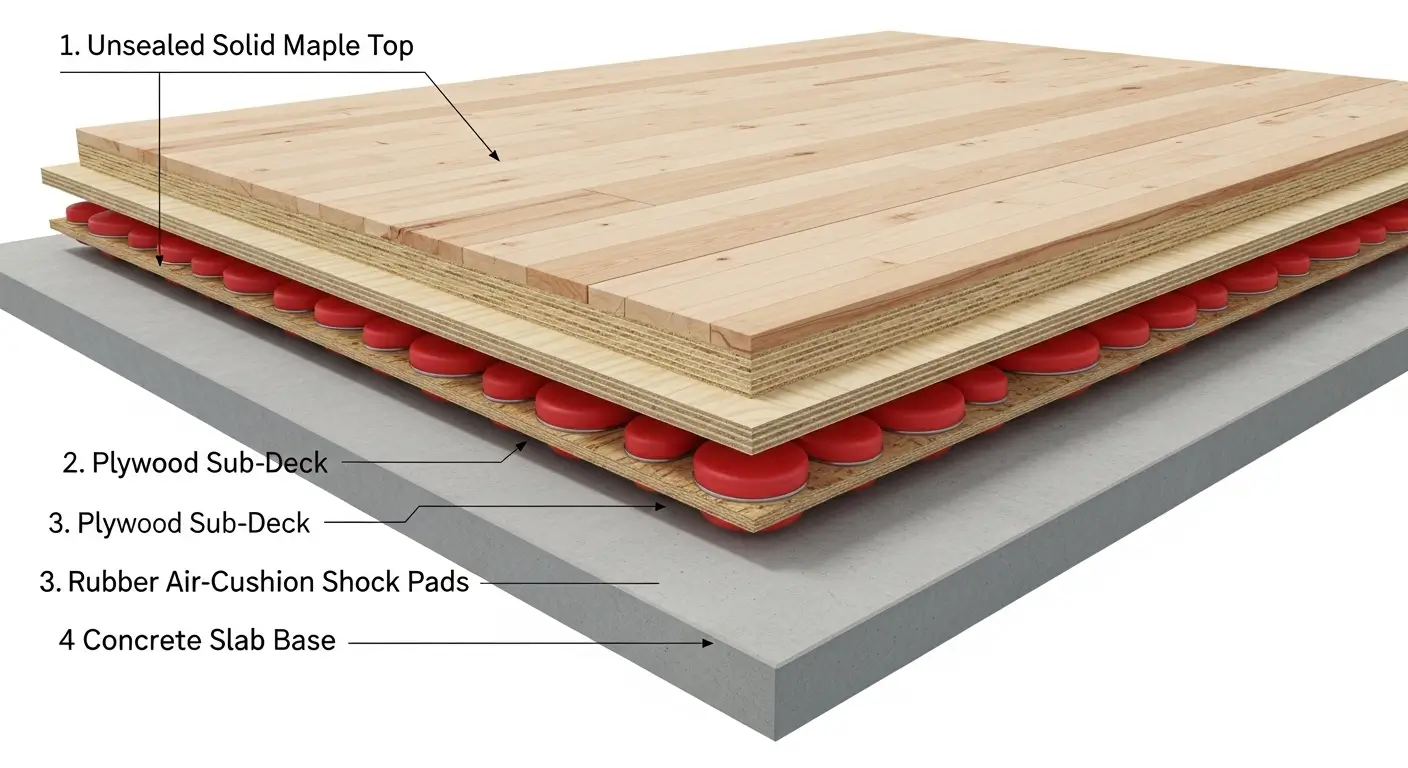
Stability is the foundation of player safety. Just as a professional basketball system requires a 48-inch concrete pier for stability, a high-performance indoor court requires a “floating” subfloor. In 2026, the gold standard is a dual-layered maple system mounted on rubber air-cushion pads.
This setup absorbs the shock of the deep lunging found in squash and the explosive, linear sprints of racquetball. However, the floor is only half the battle. Aggressive play on these high-grip surfaces can lead to joint strain if the player lacks the correct gear. Refer to our guide on the best shoes for high-friction surfaces to ensure your equipment can handle the intense lateral stress of a modern court.
The High-Stakes Choice: Material Science and 2026 Property ROI
The decision between a Squash Court vs Racquetball Court is ultimately an investment in long-term property utility. In 2026, real estate valuation for “Wellness Estates” has pivoted; an indoor court is no longer seen as a luxury niche, but as a multifunctional anchor. However, a “one size fits all” approach to construction often leads to expensive retrofits later.
When evaluating squash vs racquetball court size, consider the versatility of the footprint. A racquetball court, with its 40-foot length and 20-foot ceiling, offers the “volume” required to double as a volleyball court or a high-end golf simulator room. A squash court is a more compact, precision-engineered environment that appeals to a demographic focused on the sport’s recent Olympic elevation.
The Olympic Spec: Future-Proofing for the LA28 Boom
With Squash officially joining the LA28 Olympic Games, the benchmark for “quality” has shifted. If you are building in 2026, a court that doesn’t meet World Squash Federation (WSF) Level 1 standards may suffer in resale value.
The defining feature of a modern Olympic-spec conversion is the Adjustable Motorized Tin. In the past, the “tin” (the metal strip at the front of the court) was fixed. Today, high-performance courts utilize a motorized system that toggles between the 17-inch professional height and the 19-inch amateur height. This ensures that as a player’s skill level evolves, the court evolves with them.
2026 Court Conversion: Real-World Cost Expectations
| Component | Estimated Cost (USD) | The Engineering Reality |
| Glass Back-Wall | $7,000 to $9,000 | Mandatory for safety and AI-tracking camera visibility. |
| Motorized Tin | $1,200 to $1,800 | Essential for “Olympic Level” training flexibility. |
| High-Grip Floor Sanding | $3,000 to $4,500 | Prevents “surface slickness” common in older multi-sport gyms. |
| Acoustic Fiberesin Panels | $5,000 to $7,500 | Absorbs the 190 mph “thud” to prevent noise pollution in the home. |
Friction Physics: Why “Standard” Floors Fail
The footwork in a squash court vs racquetball court requires different surface physics. Squash involves “deep-lunging” where the player’s weight is shifted forward onto a single foot. This requires a floor with a high coefficient of friction to prevent the shoe from sliding out.
Conversely, racquetball requires linear, explosive sprinting. A floor that is too grippy can actually lead to ankle roll. This is why the 2026 gold standard is unsealed Beech or Maple. Unlike basketball floors, which are coated in shiny urethane, racquet courts are sanded and left “open-pored” to allow for maximum moisture absorption and grip.
The Friction Coefficient Quote: “The biggest risk in a DIY court is the floor finish. If you apply a standard lacquer to a squash floor, you aren’t just making it shiny; you’re making it a skating rink for someone attempting a 180-degree lunge. Authenticity in court design starts with the wood-to-shoe connection.” : Head of Sports Safety Engineering, 2026.
FAQ,S
What is the real-world cost of a residential sport court in 2026?
According to the American Sports Builders Association (ASBA), a professional-grade indoor court ranges from $45,000 to $120,000. This depends heavily on whether you are retrofitting an existing basement or adding a detached structure with dedicated HVAC.
Are squash and racquetball courts the same?
No. They are structurally distinct. A racquetball court is essentially a 40-foot tunnel with no “out” on the ceiling. A squash court is a 32-foot strategic box with a metal “tin” on the floor and a strict “out” line on the ceiling.
Can you play racquetball on a squash court?
Technically yes, but the experience is “cramped.” A 190 mph racquetball returns from a 32-foot front wall significantly faster than a squash ball, leaving players with almost no time to complete their swing arc. It is safer to play Squash 57 (a hybrid game) on these courts instead.
Conclusion: The Final Decision
The squash court vs racquetball court choice is a balance between the raw, high-velocity power of racquetball and the refined, tactical strategy of Olympic-bound squash. By prioritizing World Squash Federation technical tolerances and utilizing unsealed, high-grip materials, you ensure your facility is not just a room, but an authentic training asset.