
 By Ghulam Mustafa Khan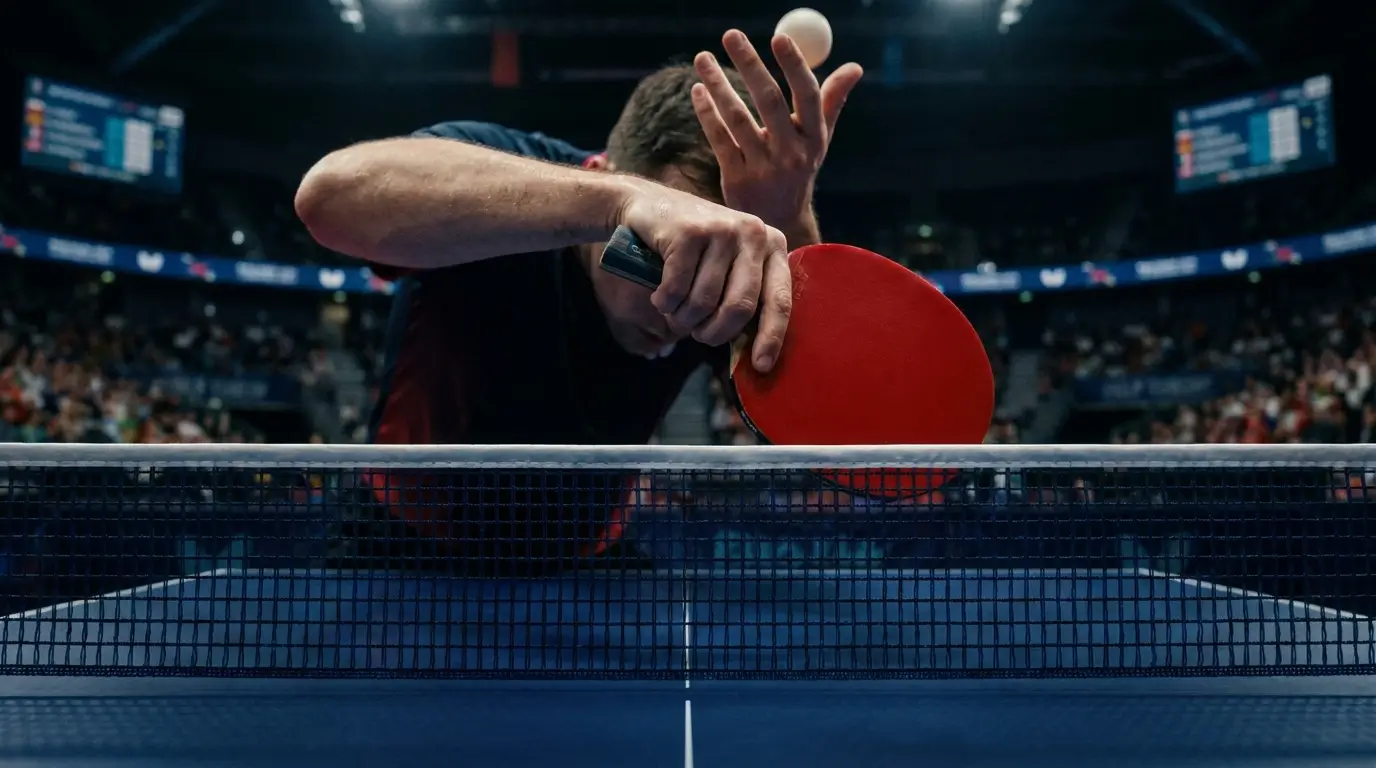
You step up to the table, completely dialed in. Your opponent tosses the ball, their racket flashes, and you make what feels like a perfectly timed contact. Instantly, the ball rockets ten feet past the baseline or dives violently into the bottom of the net. You immediately curse your slow reflexes or blame a sudden lapse in your hand-eye coordination.
Stop right there. Your reflexes are completely fine.
The brutal reality is that you are losing because you are playing blind. You are reacting to the plastic ball instead of reading the player holding the racket. At the beginner level, the game is simply about keeping the rally alive. But as you transition into competitive, high-stakes play, mastering the skill of reading table tennis spin becomes the single most critical factor in your development.
It separates the casual basement player from the tournament threat. If you do not understand the mechanical forces your opponent is applying to the ball at the exact point of contact, you are quite literally guessing on every single return. And in racket sports, guessing is the fastest route to losing.
The Illusion of Speed and the Reality of Rotation
Many players completely misunderstand the fundamental nature of the sport. If you look at our comprehensive breakdown on the difference between table tennis and ping pong, you will notice that casual “ping pong” relies heavily on flat hits, simple pushes, and keeping the ball in play. High-level table tennis, however, is a hostile environment governed almost entirely by extreme rotation.
When you struggle with how to read spin on table tennis serves, you are usually making the classic amateur mistake: watching the ball after it crosses the net. By the time the ball is halfway across the table, the spin has already dictated its future.
The secret to anticipation is not tracking the plastic sphere. The secret lies in decoding the physics happening in your opponent’s hand before the ball ever leaves their side of the court.
The Biomechanics of Rotation: Tangent Contact and Mechanical Grip
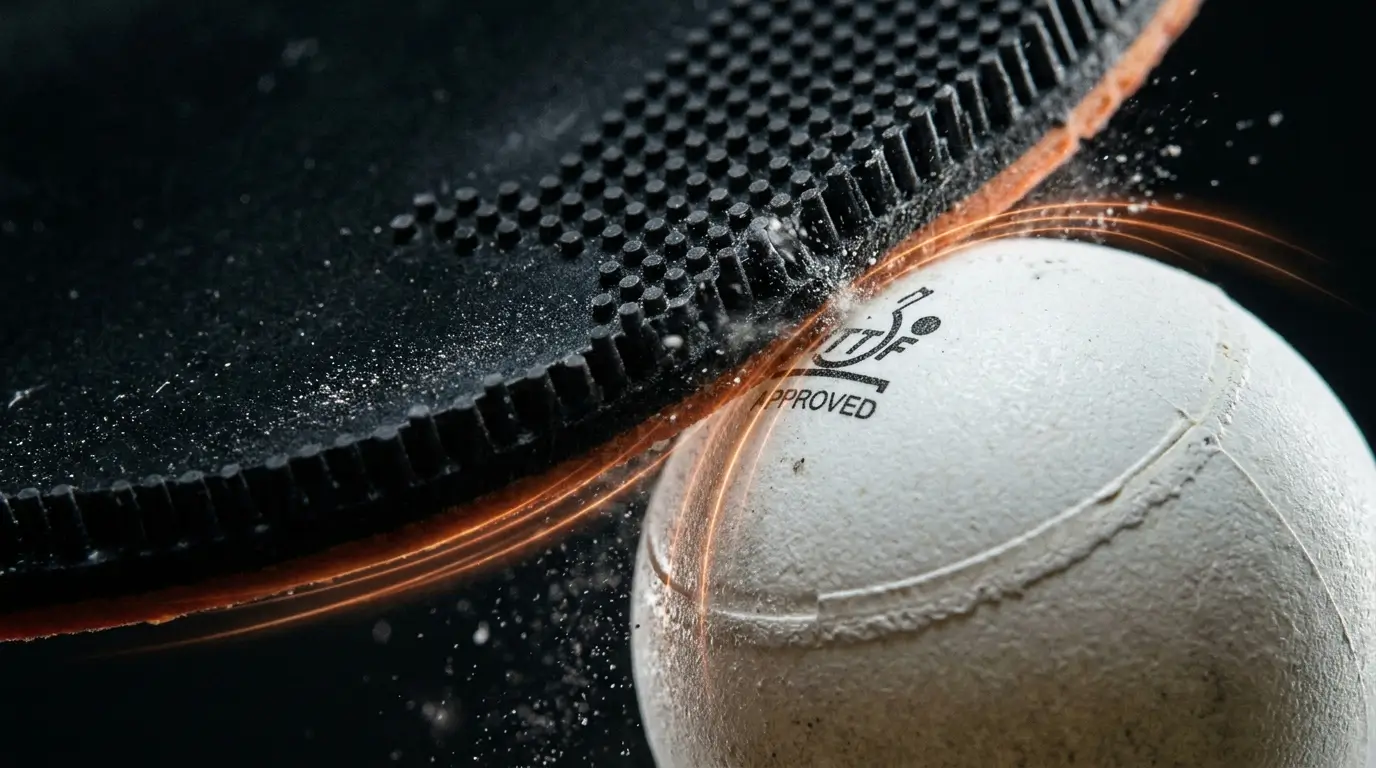
To accurately anticipate what the ball will do off your paddle, you must first understand exactly how spin is manufactured. A standard table tennis ball weighs a mere 2.7 grams. When a player strikes it with a thick, highly textured rubber surface, they are exploiting two specific physical concepts: mechanical grip and tangent contact.
The Flat Hit: When an opponent hits the ball completely flat, all their kinetic energy goes directly through the center of the ball. This produces high speed but zero spin.
The Brush (Tangent Contact): When a player uses a “brushing” motion, they strike the ball at a sharp angle, grazing the outside surface. The friction between the inverted rubber of the paddle and the plastic ball creates a violent rotation.
The amount of mechanical grip their racket possesses dictates the absolute ceiling of that rotation. When you see a player take a massive, aggressive swing but the ball travels relatively slowly over the net, red alert bells should ring in your head. That physical energy did not disappear. It was converted entirely into heavy rotation.
The Equipment Trap: Are Your Pro-Level Rubbers Betraying You? Your equipment dictates your vulnerability to spin. High-tension inverted rubbers provide maximum mechanical grip, allowing you to generate heavy topspin, but they also make you incredibly sensitive to your opponent’s incoming spin. If you are constantly struggling to keep heavy spin serves on the table, consider the friction level of your current paddle setup. Switching to a rubber with less surface tackiness can temporarily increase your margin of error while you develop your reading skills.
The Magnus Effect: Why the Ball Lies to Your Eyes
Once the ball leaves the racket, it is no longer just a moving object; it is a miniature aerodynamic engine. This is where physics actively tricks your vision.
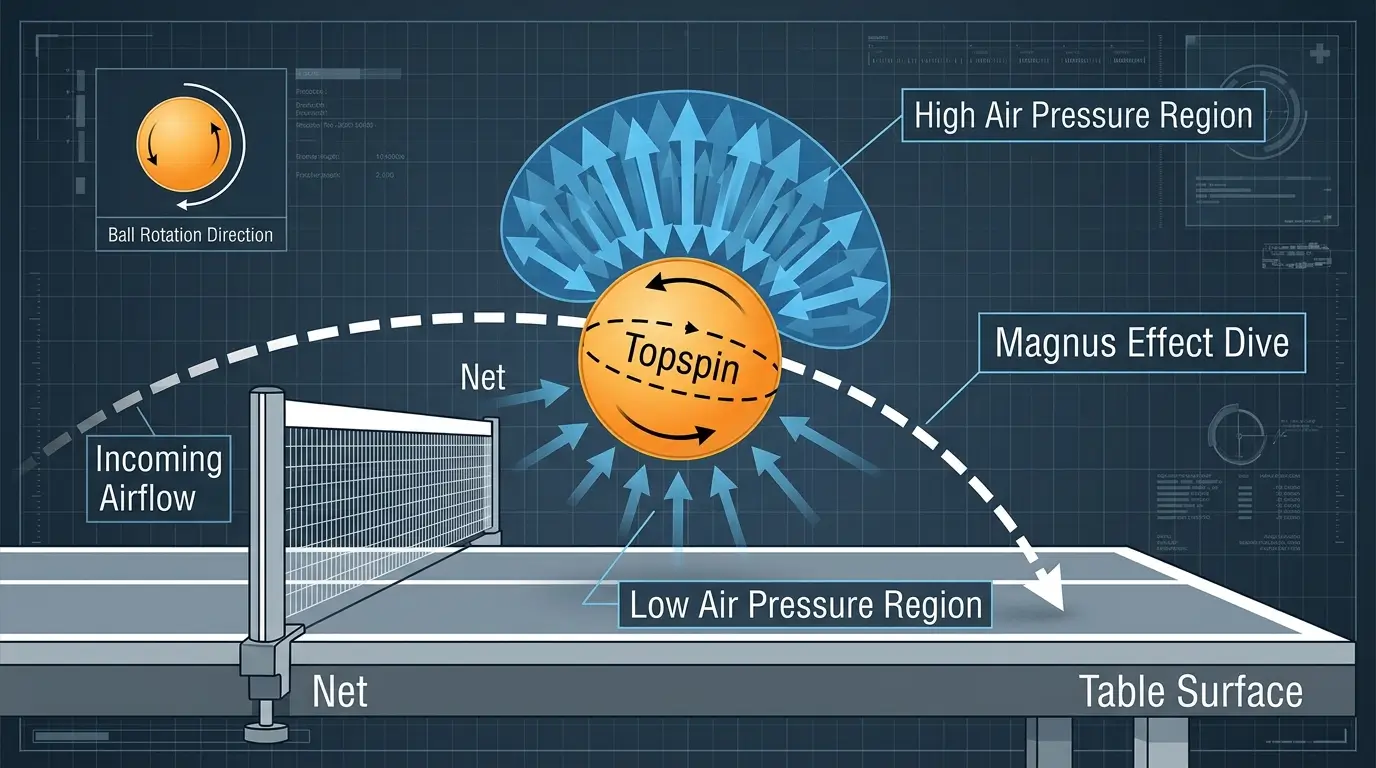
As a spinning ball moves through the air, it drags a thin microscopic layer of air along with it. This creates a pressure difference on opposite sides of the ball, a phenomenon scientifically documented as the Magnus effect by aerospace engineers. Understanding this principle is mandatory for mastering topspin vs underspin visual cues.
Topspin Mechanics: When your opponent generates heavy topspin, the top of the ball rotates forward, in the same direction the ball is traveling. This creates higher air pressure on top of the ball, forcing it to dive aggressively downward. This is why topspin shots can be hit with extreme, violent power and still land safely on the table.
Underspin (Backspin) Mechanics: Underspin rotates backward. The high pressure builds up underneath the ball, creating lift. The ball will appear to float or stall in the air, defying gravity momentarily before skidding low off the bounce.
If you are waiting for the bounce to tell you what spin is on the ball, the Magnus effect has already manipulated your timing, forcing you to strike the ball late, off-balance, and out of position.
The Coach’s Blunt Truth: The Racket Face Never Lies
I watch players lose their minds trying to read complex pendulum serves by staring at the ball’s trajectory. Stop watching the flight path. I tell my students to lock their eyes entirely on the opponent’s wrist and racket angle at the exact millisecond of impact. The trajectory can be deceptive due to air pressure, but the face orientation never lies. If the racket face is open (pointing up) at contact, underspin is coming. If it is closed (pointing down), prepare for topspin.
You cannot fix your unforced errors until you understand the science of the attack. By recognizing how tangent contact and aerodynamic pressure work against you, you build the foundation needed to properly diagnose incoming shots. To excel at any court sport, from optimizing your solo tennis practice to reading a spinning 40mm ping pong ball, spatial awareness and mechanical understanding are your ultimate weapons.
Diagnosing the Server: Exposing the Pre-Strike Rituals
You understand the physics now. But knowing how tangent contact works will not save you when a 40mm ball is flying at your face at 60 mph. You need a system to apply that knowledge under extreme pressure.
Successfully reading table tennis spin requires you to become a detective during your opponent’s pre-strike ritual. The majority of club players only focus on the ball after it leaves the server’s racket. This is a fatal tactical error. You must push your point of focus forward in time.
The International Table Tennis Federation (ITTF) mandates that the service toss must rise at least 16 centimeters vertically from the palm of the free hand. The server cannot hide the ball with their body. This rule exists to give you a fighting chance. Use those crucial milliseconds while the ball is airborne to lock your eyes aggressively onto the server’s wrist, elbow, and racket face.
Watch the kinetic chain of the server. If their elbow drops sharply during the downswing, they are preparing to chop underneath the ball for underspin. If their shoulder drops and they coil backward, prepare for an aggressive topspin loop.
The Mid-Flight Reality Check: The “Logo Blur” Technique
Let us assume you missed the contact point. The server disguised their motion perfectly, and the ball is now flying over the net. You still have one micro-visual cue left before it bounces: the ball’s logo.
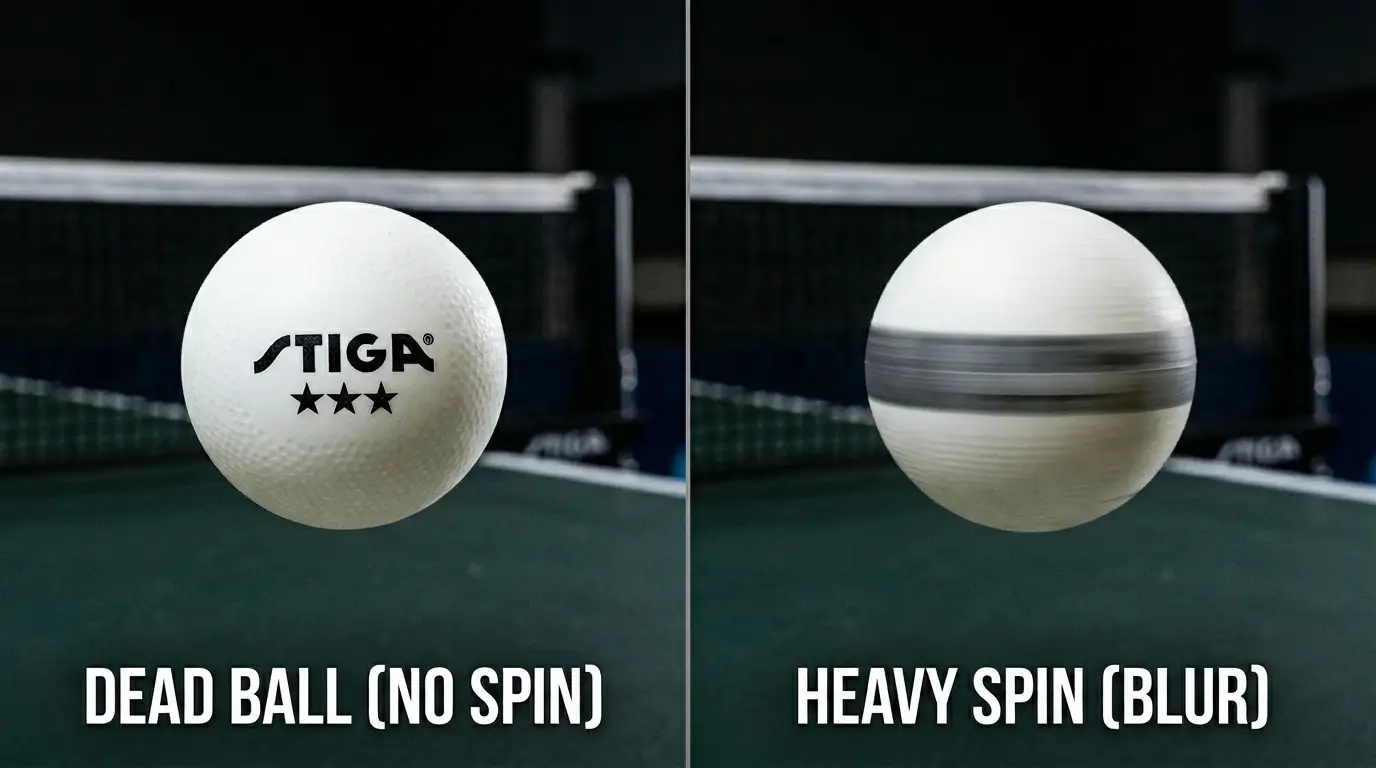
This is a veteran trick for reading table tennis spin mid-flight. Standard tournament balls feature high-contrast branding logos. Your brain can process the visual distortion of that logo to calculate rotation intensity.
- The “Dead Ball” Read: If you can clearly read the brand name (like Nittaku or DHS) or see the distinct shape of the logo as the ball floats toward you, there is zero spin. It is a flat, dead ball. Attack it immediately.
- The “Blur Stripe” Read: If that logo turns into a solid, rapid blur or a continuous colored stripe around the ball, you are facing massive, heavy rotation.
The Tactical Reality Check: Stop Freezing at the Baseline
When intermediate players see that blurry logo indicating heavy spin, their feet turn to cement. They panic, back away from the table, and let the ball drop perfectly into their opponent’s strike zone. Never yield the table purely out of fear. Step in and catch the ball right off the apex of the bounce. Taking the ball early cuts down the time the spin has to react aggressively off the table surface, giving you a tighter window to block it back successfully.
Dissecting Complex Variations: Pendulum and Tomahawk Serves
Topspin and underspin are linear. Sidespin is where the real mind games begin. The Pendulum and Tomahawk are the two most lethal serves in competitive table tennis precisely because they blend lateral movement with heavy rotation.
The Pendulum serve uses an inward wrist snap, causing the ball to kick sharply to your right (if facing a right-handed server). The Tomahawk serve uses an overhead, chopping motion that kicks the ball violently to your left.
To neutralize these serves, you cannot just push the ball forward. You must manually angle your racket face into the direction the spin is coming from. If the ball is spinning aggressively to the left, you must close your racket face slightly and point it to the right to counteract that lateral force.
The Biomechanical Trap: The Spin Anxiety Death-Grip
When players struggle with reading table tennis spin, they subconsciously choke up on their paddle. They grip the handle with maximum tension, hoping brute force will control the ball. This is mechanically disastrous. A rigid wrist cannot absorb rotation. It acts like a brick wall, causing the spin to ricochet wildly. Just as finding the correct tennis elbow grip size is critical for arm health and fluid swing mechanics on a hard court, maintaining a relaxed, pliable grip in table tennis allows your hand to absorb the shock of a heavy spin serve rather than fighting it.
Visual Cues Matrix: The Server’s Tell
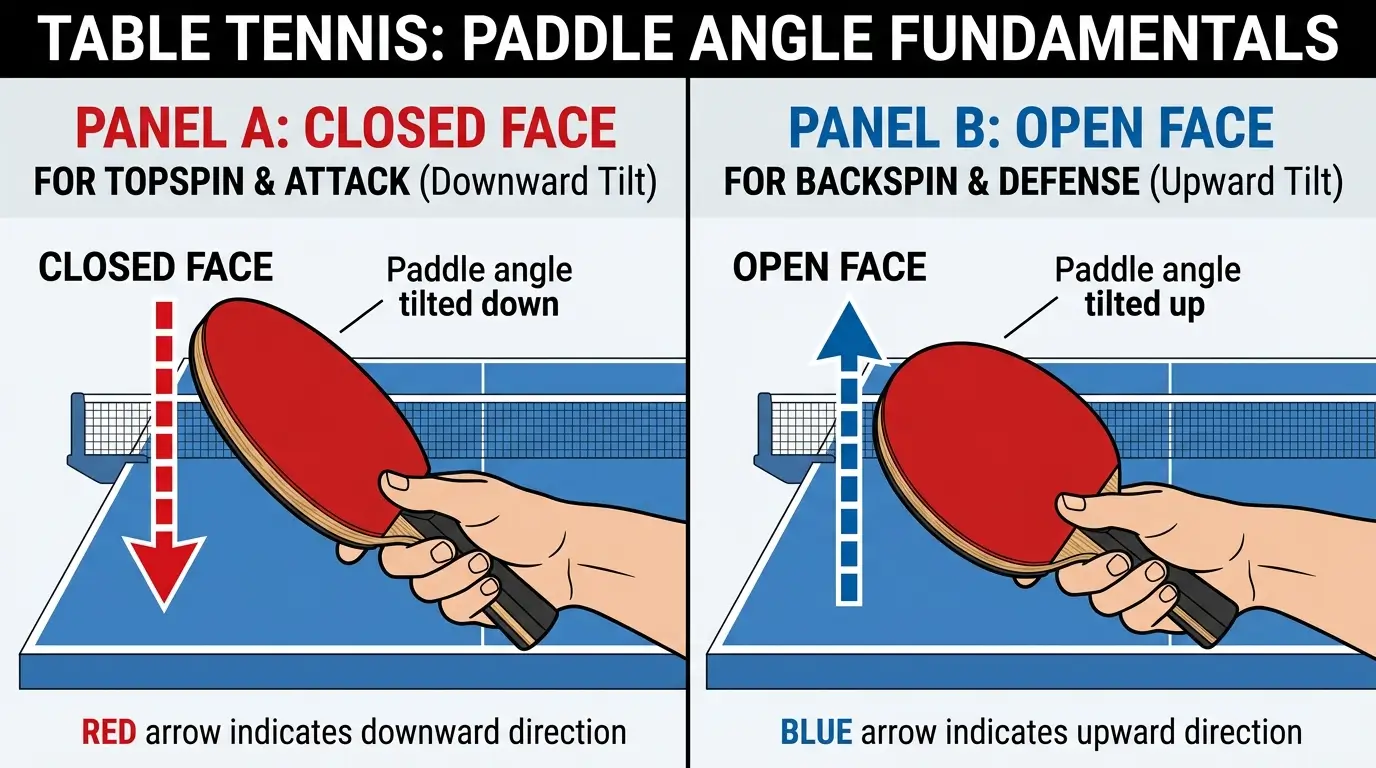
To simplify your decision-making at the table, memorize this rapid-diagnosis chart. Treat this as your mechanical cheat sheet for reading the opponent’s intent at the exact point of contact.
| Spin Type | Racket Face Angle at Contact | Swing Path Direction | The Ball’s Flight Behavior |
| Heavy Topspin | Closed (Tilted downward) | Low to High brushing | Dives sharply over the net, kicks forward on bounce. |
| Heavy Underspin | Open (Tilted upward) | High to Low chopping | Floats over the net, stalls or skids low on bounce. |
| Pure Sidespin | Vertical (Straight up/down) | Left to Right (or vice versa) | Curves sideways in the air, kicks laterally off the table. |
| No-Spin (Dead) | Flat (Square to the ball) | Direct forward push | Slower, hollow sound, logo is clearly visible mid-air. |
You now have the visual framework to spot the rotation before it ruins your return. By watching the racket face, analyzing the logo blur, and keeping a loose grip, you strip away the opponent’s primary weapon.
Counter-Measures: Neutralizing the Threat and Stealing the Point
You have diagnosed the server’s kinetic chain. You have watched the racket face at the point of contact. You have even calculated the intensity of the rotation using the “logo blur” mid-flight. You have successfully executed the mental task of reading table tennis spin. Now, you have to physically deal with it.
Identifying the rotation is completely useless if you do not immediately calibrate your own racket angle to absorb and redirect that violent kinetic energy. When a heavy spinning ball strikes your paddle, it desperately wants to continue its rotation. Your racket angle must forcefully tell it “no.”
If you read heavy topspin, that ball is going to aggressively bite your rubber and jump upward. To neutralize this, you must “close” your racket face (tilt it down over the ball) to physically cap the trajectory. Conversely, if you read heavy underspin, the ball will drag downward into the net. You must “open” your racket face (tilt it slightly upward) and use a lifting motion to force the ball over the net.
The Tactical Blueprint: Stop Fighting the Spin Axis
A massive mistake amateur players make is trying to hit straight through heavy sidespin. If the opponent’s pendulum serve is kicking the ball violently to your left forehand, do not push straight forward. You must angle your paddle face to point slightly right. You are essentially using the opponent’s own rotational energy against them, banking the ball back off their spin axis.
The Degradation of Equipment vs. Player Skill
Your ability to execute these counter-measures is heavily reliant on the condition of your gear. You can be an expert at reading table tennis spin, but if you are playing with an oxidized, five-year-old paddle, your tactical knowledge is wasted.
Just as meticulous pickleball paddle maintenance is required to keep a carbon-fiber face gritty and responsive, regularly replacing your table tennis rubbers is non-negotiable. When table tennis rubber oxidizes, it loses its “tackiness” and mechanical grip. When you attempt a tangent contact brush with dead rubber, the ball will simply slip off the surface.
If you want to play an aggressive counter-attacking game, consult the equipment standards outlined by USA Table Tennis (USATT) to ensure your rubbers have the legal friction coefficients required to grip a spinning ball. You cannot fight physics with dead equipment.
The Guesswork Matrix: Offensive vs. Defensive Returns
When you are unsure of the spin—perhaps the opponent disguised their contact point perfectly—you face a critical choice. Do you attack the unknown, or do you defend it?
| Return Strategy | The Execution | Pros | Cons (The Risk) |
| Offensive (Counter-Loop) | Aggressive forward brushing motion, brushing over the ball. | Overpowers weak spin; puts immense pressure back on the server. | Extremely low margin of error. If you misread heavy underspin, you will dump the ball into the net. |
| Defensive (Push / Block) | Passive, open racket face, taking the ball early off the bounce. | High safety margin. Keeps the rally alive when you fail at reading table tennis spin. | Often results in a “pop-up,” giving your opponent an easy smash winner on the next shot. |
The Coach’s Reality Check: The Ego Trap of the “Hero Shot”
I constantly see intermediate players attempt to violently smash a serve when they haven’t accurately read the spin. They are playing purely on ego. If you fail to read the rotation, do not attempt a hero shot. Default to a passive, controlled block aimed squarely at the middle of the opponent’s body. The middle is the most awkward placement for a table tennis player to attack, forcing them to quickly choose between a forehand or backhand. Buy yourself time and wait for a ball you can actually read.
The Evolution of Your Court Awareness
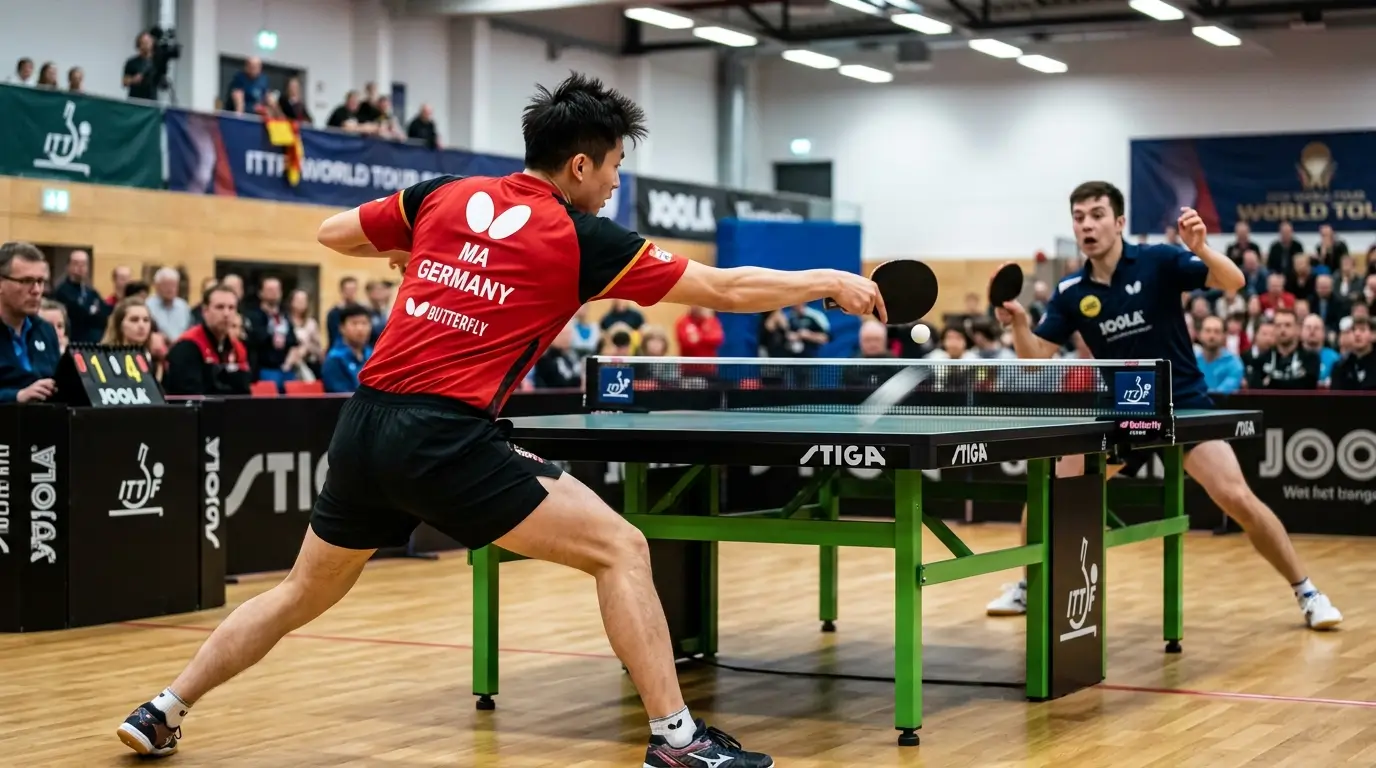
Stop stepping up to the table hoping your reflexes will save you. Fast hands will never beat a prepared mind. The game of table tennis is a relentless, high-speed chess match played with aerodynamic pressure and material friction.
By aggressively focusing your eyes on the server’s elbow, memorizing the crucial racket face angles, and trusting the logo blur, you strip away the invisible advantage of rotation. Mastering the art of reading table tennis spin shifts you from a reactive, fearful player into an educated, lethal counter-attacker.
Frequently Asked Questions on Spin Diagnosis
Why do my returns always pop up high in the air for an easy smash?
You are misreading topspin or no-spin serves as underspin. When you hit a topspin ball with an open (upward-facing) racket, the forward rotation bites your rubber and climbs the face of your paddle, launching it vertically.
Can you learn reading table tennis spin without a coach?
Yes, but it requires intentional practice. Stop playing matches to “win” and spend a week playing matches solely to watch your opponent’s racket at the point of contact. Record your sessions on a smartphone to analyze the kinetic chain you are missing in real-time.
Does the color of the rubber (Red vs. Black) affect the spin?
Historically, yes. Black rubbers used carbon mixtures that made them slightly tackier, while red rubbers were marginally faster. Today, high-end manufacturers have largely equalized the performance, but elite players still often reserve the black side for their primary spin-generating forehand.
How do you return a heavy underspin (backspin) serve?
You have two options: open your racket face and gently “push” under the ball to match the spin, or drop your racket low, use your legs, and execute a heavy, upward brushing loop to physically reverse the spin.
What is the difference between brushing and hitting flat?
Hitting flat transfers all kinetic energy through the center of the ball, prioritizing pure speed. Brushing (tangent contact) grazes the outside of the ball, converting your swing speed into rotation via mechanical friction.