
 By Ghulam Mustafa Khan
The temperature drops below freezing, you look out at your newly installed backyard investment, and panic sets in. The first major snowstorm is on the radar, and your immediate instinct is to treat your playing surface exactly like your driveway. You grab a metal snow shovel, buy a 50-pound bag of standard rock salt, and plan to scrape the ice away so you can keep shooting hoops through December.
Drop the shovel immediately. You are about to cause catastrophic, irreversible damage to your property.
The harsh reality of winterizing sports court surfaces is that standard residential de-icing methods ruin more athletic facilities than the actual winter weather. Whether you dropped significant money on an acrylic residential sport court or laid down premium modular tiles, your court is a highly engineered system. It is not a driveway. If you attack it with abrasive chemicals and high-friction metal blades, you will be looking at thousands of dollars in resurfacing costs by April.
Protecting your court requires a strict understanding of material science, thermal physics, and proactive maintenance.
Effective winterization starts during the installation phase. If you are preparing your driveway surface for sport tiles correctly by sealing fissures and ensuring a 1% grade, you’ll prevent the ice-heaving that ruins courts in January.
The Physics of the Freeze: Hydrostatic Pressure and Surface Delamination
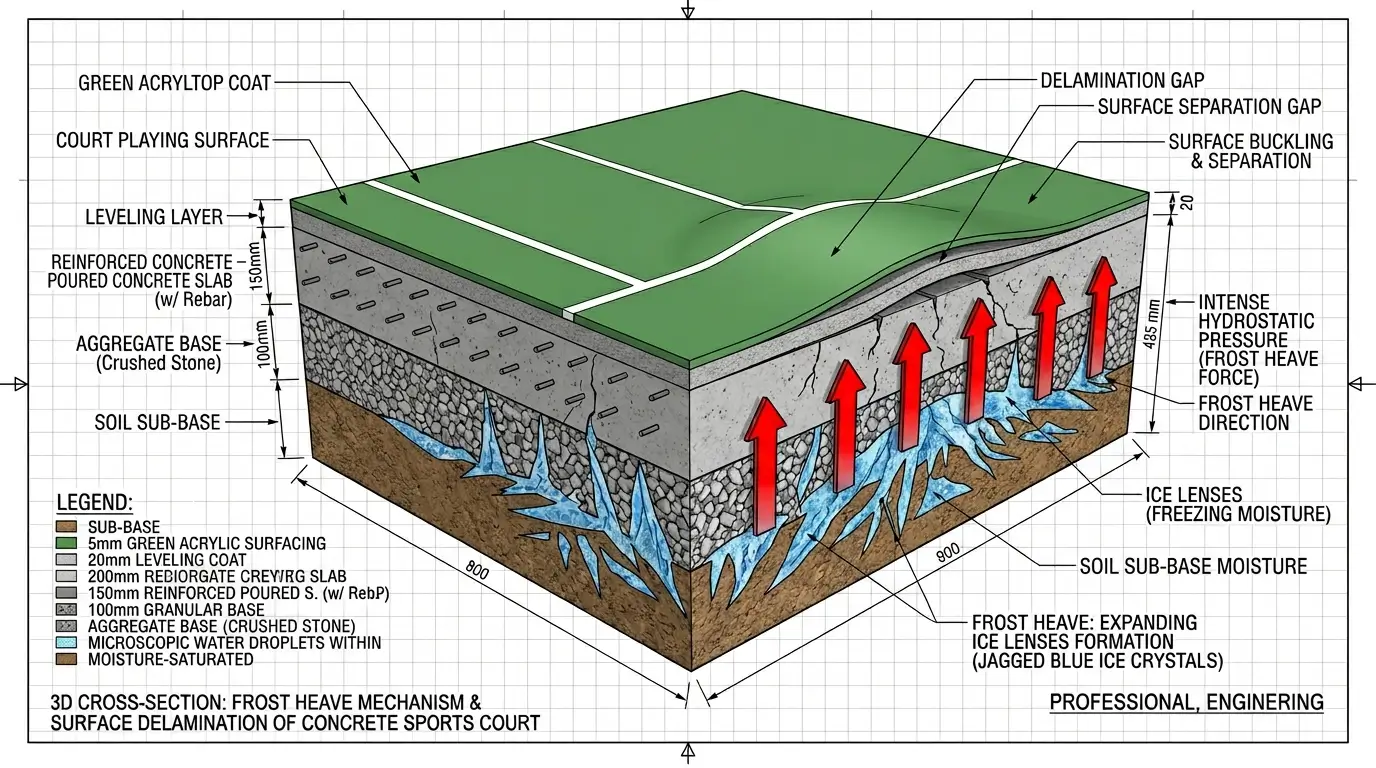 To successfully execute a winterizing sports court protocol, you must first understand the invisible enemy: the freeze-thaw cycle.
When rain or melted snow penetrates the microscopic pores of poured concrete or asphalt, it sits in the sub-base. When the temperature drops below 32°F (0°C), that trapped water freezes and expands by approximately 9%. This expansion generates massive upward force, scientifically defined as hydrostatic pressure. According to structural data from the Portland Cement Association on freeze-thaw degradation, this repeated expansion and contraction physically shatters the internal bonds of the material.
On a standard driveway, this causes minor flaking. On an athletic hardcourt, it causes surface delamination. The multi-layered acrylic resurfacer—the colored coating that gives your court its grip and vibrant look—is forcefully separated from the concrete base. Come spring, you will find massive, peeling dead spots that completely kill the bounce of a basketball and pose a severe tripping hazard for tennis and pickleball players.
The Coach’s Blunt Truth: The “One More Game” Illusion
I constantly see addicted players trying to force a session in 25-degree weather by hastily chipping away ice patches with a garden spade. Stop it. Not only are you gouging your acrylic surface, but playing on a frozen hardcourt is a biomechanical nightmare. The court has zero shock absorption, and the rubber in your shoes turns to rigid plastic. You are transferring violent kinetic shock directly into your knees and lower back just to hit a dead, frozen ball. Let the court rest.
Thermal Contraction: Polypropylene Tiles vs. Poured Hardcourts
The specific strategy for winterizing sports court setups depends entirely on your surface material. Poured hardcourts handle cold differently than suspended, interlocking tiles.
If you chose a suspended surface—like polypropylene modular tiles designed to save your knees—you must account for aggressive thermal contraction. Polypropylene is a high-impact plastic that physically shrinks in freezing temperatures.
A high-quality interlocking tile system is engineered with built-in expansion joints to absorb this movement. However, if debris, packed dirt, or autumn leaves have become wedged between the interlocking pegs during the summer, the tiles cannot contract evenly. Instead of shifting, the plastic locks up and snaps under the immense tensile stress of the cold.
The Equipment Trap: Ignoring Your Drainage Clearances Before the first freeze hits, you must perform a mandatory debris sweep. If you have a modular tile court, use a high-powered leaf blower to aggressively clear the weep holes and the expansion gaps between the tiles. If water cannot drain through the tiles and away from the sub-base, it will pool under the plastic, freeze solid, and cause severe sub-base heaving (ground heave), warping the entire playing surface upward.
If you have a traditional acrylic or asphalt court, thermal contraction manifests as surface tension. The asphalt shrinks, pulling tightly across the sub-base. Any existing hairline crack—even one the width of a piece of paper—will be ripped wide open by January. You must fill these micro-fissures with a flexible, rubberized crack sealant before the ambient temperature drops below 50°F. Once the freeze sets in, liquid sealants will not cure, leaving the sub-base entirely exposed to snowmelt.
Drainage Diagnostics: Unlocking the Moisture Migration Paths
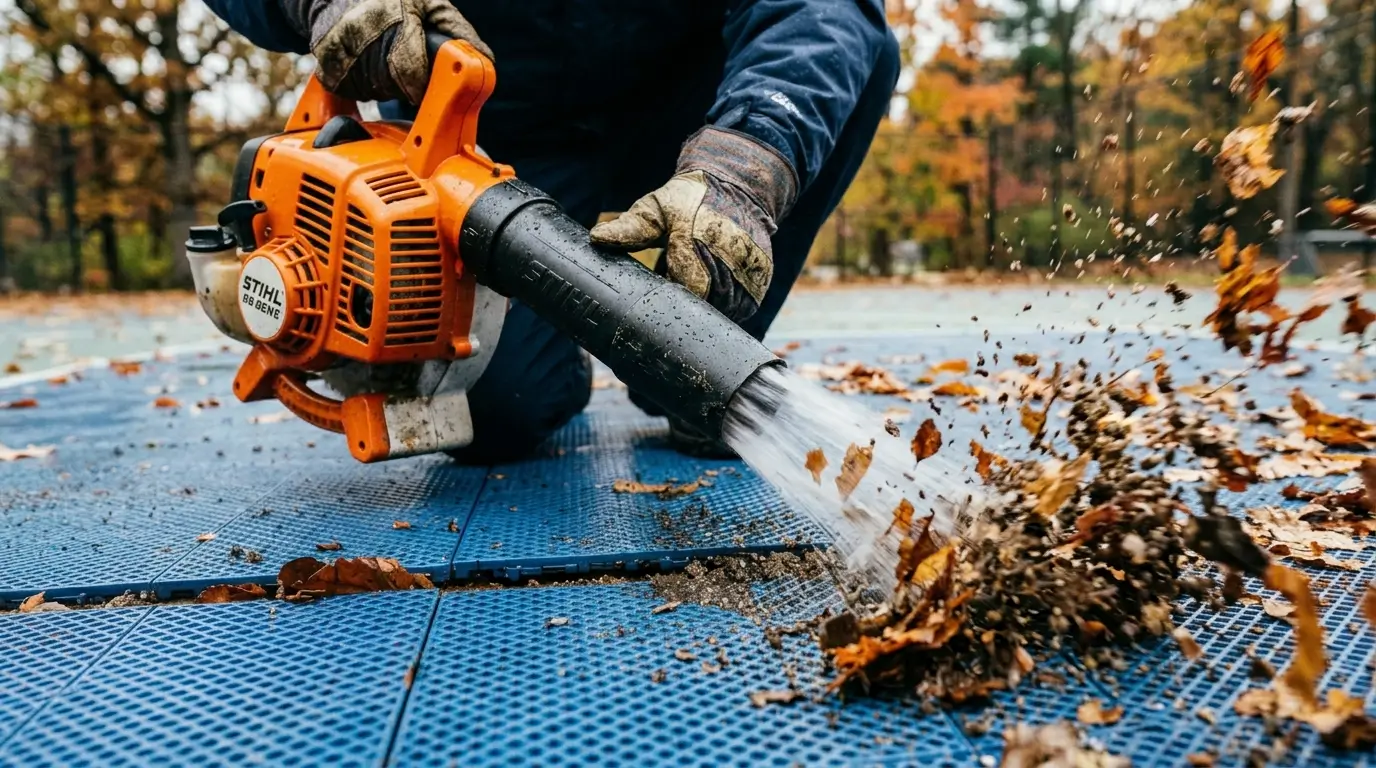
Before the first snowflake even hits the ground, your court must be surgically clean. Many homeowners assume that autumn leaves and pine needles are just an aesthetic nuisance. In reality, organic debris is a sponge. It traps moisture directly against your acrylic layers or jams the microscopic expansion joints of your modular tiles.
Properly winterizing sports court surfaces begins with a high-velocity debris sweep. Do not use stiff-bristled brooms or metal rakes, which can score the surface. Use a high-powered leaf blower to force all trapped moisture out of the weep holes and drainage slopes.
If you have acidic organic matter sitting on the surface—which we detail extensively in our guide on cleaning bird droppings from sport court tiles—it must be scrubbed off before the freeze. When acidic matter freezes to a poured court, it eats through the UV-protective coating and permanently stains the playing surface by spring.
The Gear Reality Check: Releasing the Tension
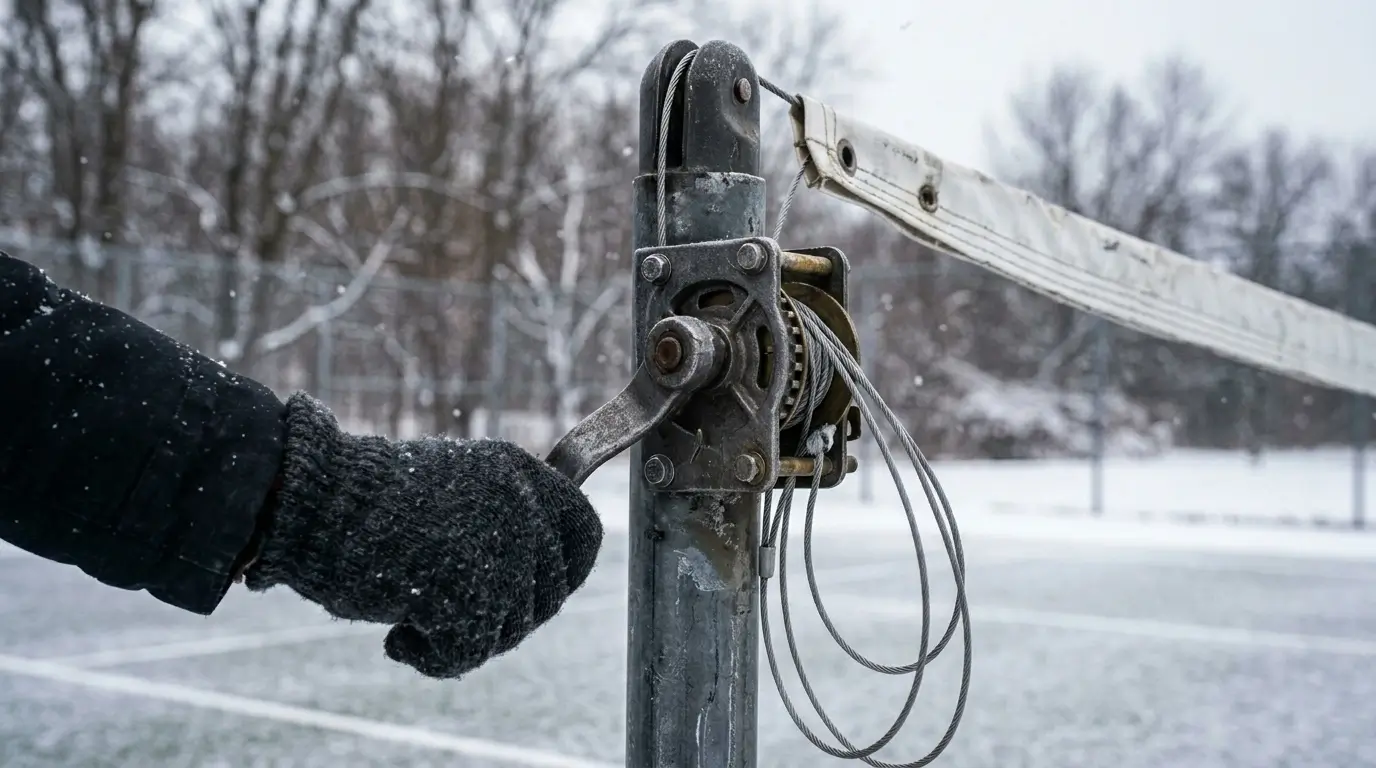
Your court hardware is just as vulnerable to thermal contraction as your playing surface. The most expensive mistake amateur court owners make is leaving their net systems fully tensioned from November to March.
According to the official facility guidelines established by the United States Tennis Association (USTA), tournament nets are kept under immense mechanical stress to maintain the regulation 36-inch center height. When the temperature plummets, the steel cable inside the net headband physically shrinks. If your net is already cranked to its maximum tension, that sudden thermal contraction will violently pull the metal net posts inward. By the time the snow melts, your posts will be permanently bent, and your ground sleeves may be cracked.
The Hardware Trap: The 5-Minute Net Rescue You do not necessarily have to completely remove your net and store it indoors, though that is the safest option. At the absolute minimum, you must disengage the crank. Turn the winding mechanism counter-clockwise until the net is visibly sagging and resting loosely on the court surface. This completely removes the tensile stress from the posts, allowing the steel cable to contract harmlessly as the temperature drops.
If you are dealing with temporary setups, such as addressing a sagging portable pickleball net, entirely dismantle the system and store it in your garage. Portable bases are not designed to withstand hydrostatic pressure and will crack open if water freezes inside their weighted cavities.
Hoop Mechanics: Hydraulic Freezing and Backboard Vulnerability
If your backyard court features a premium adjustable basketball system, winterizing your sports court requires locking down the actuator.
The crank systems on heavy-duty driveway basketball hoops utilize internal hydraulic cylinders or threaded steel gears. If moisture penetrates this mechanism and freezes, the gears become encased in solid ice. If a player attempts to raise or lower the hoop while the internal components are frozen, the steel gears will instantly shear off, rendering a $2,000 system completely useless.
Before the deep freeze sets in, lower the backboard to its lowest possible setting (usually 7.5 feet). This serves two mechanical purposes:
It physically retracts the vulnerable lifting cylinder back into its protective housing, shielding it from moisture.
It drastically reduces the hoop’s center of gravity, preventing violent winter windstorms from tipping the system or tearing the anchor bolts out of the concrete base.
The Coach’s Blunt Truth: Shattering the Illusion of Winter Dunking
Do not let your kids practice aggressive dunks in 20-degree weather. Both tempered glass and polycarbonate backboards undergo a massive drop in impact resistance when frozen solid. They become incredibly brittle. A rim-rattling dunk that the backboard easily absorbs in July can cause a catastrophic, spider-web shatter in January. Furthermore, the fluid inside standard break-away rim springs thickens in the cold, causing the rim to lock up rather than flex.
By aggressively clearing your drainage paths, releasing the mechanical tension on your nets, and lowering your hoops to weather the storm, you completely neutralize the physical threats of the freeze-thaw cycle.
Active Snow Removal: The High-Friction Threat
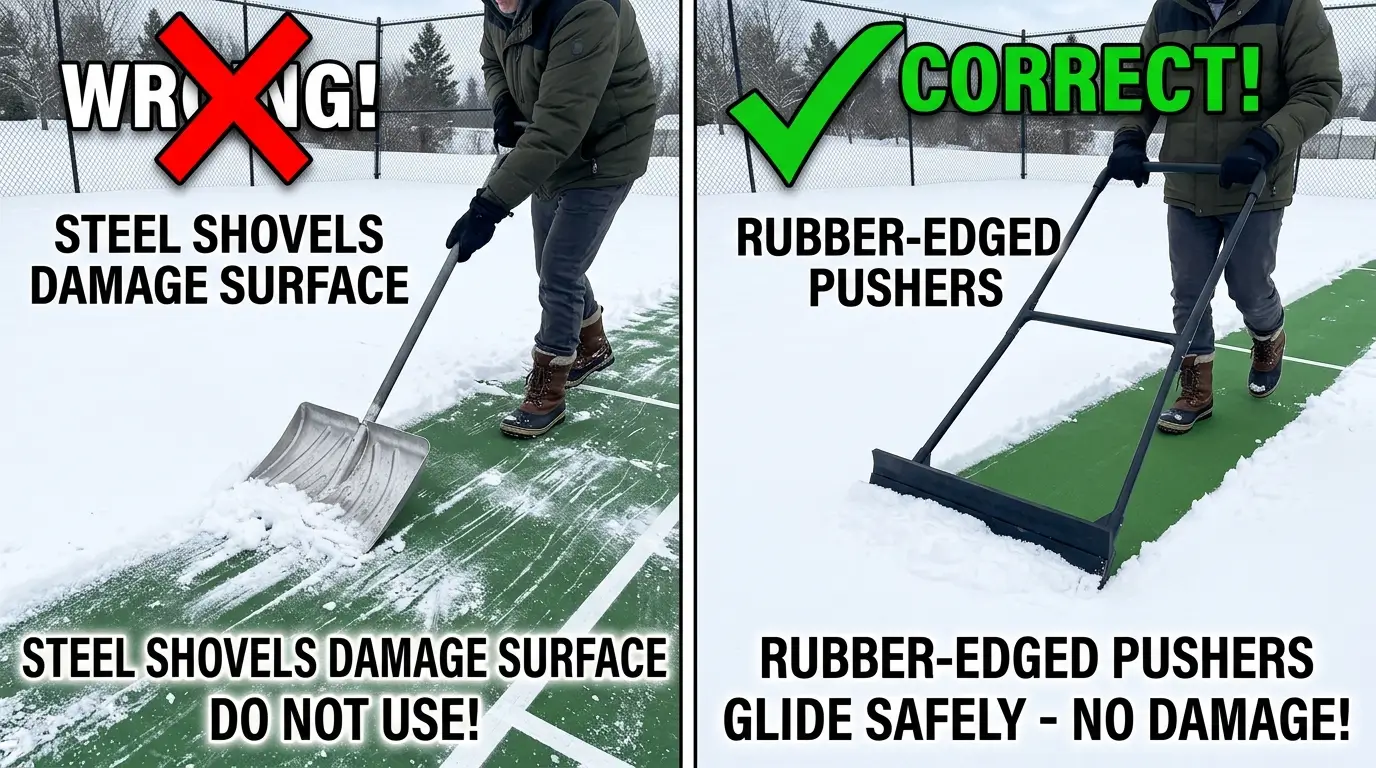
When the blizzard finally hits, your impulse will be to clear the court immediately. If you have followed the proper protocol for winterizing sports court surfaces, your sub-base is protected, and your hardware is locked down. Now, you must execute safe snow removal without physically gouging your acrylic layers or snapping your polypropylene tiles.
Do not use a standard metal snow shovel or a motorized snowblower with steel augers. A single careless pass with a steel blade will slice directly through your acrylic resurfacer, exposing the raw concrete to moisture. Similarly, the intense vibration and aggressive tracks of a heavy snowblower can shatter frozen modular tiles.
Instead, rely on wind and soft friction. For light dustings, a high-powered leaf blower is your safest tool. For heavy accumulation, you must use a wide, rubber-edged snow pusher. A rubber edge glides cleanly over both textured hardcourts and interlocking tiles without causing mechanical abrasion. Once the season is over, stash these specific rubber-edged tools in your garage sports storage so they are not accidentally used for the driveway and ruined.
The De-Icing Decision Matrix: Chemical Warfare on Your Court
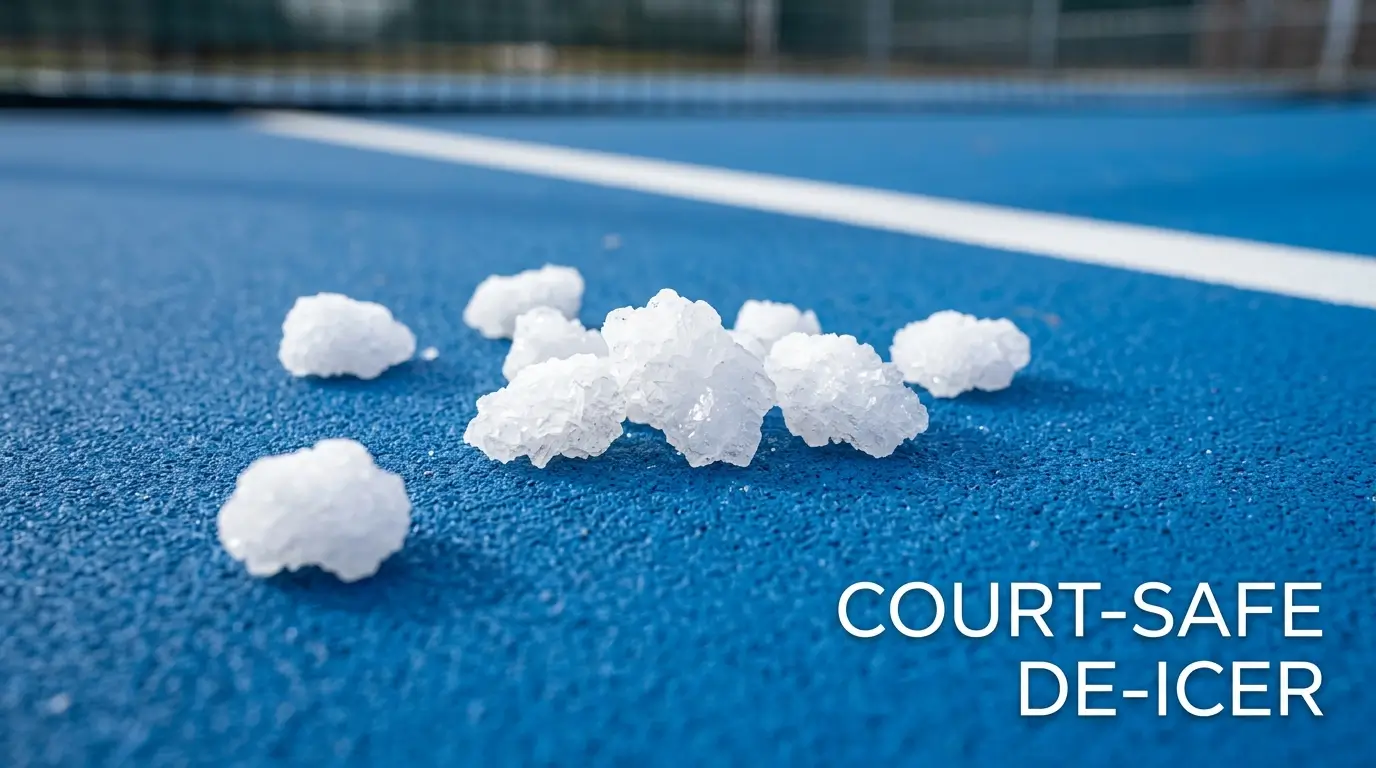
If ice forms, you face a critical chemical choice. Throwing the wrong chemical on your court will literally burn the color out of your acrylics and deteriorate the plasticizers in your modular tiles. According to environmental and concrete safety data from the Environmental Protection Agency (EPA), not all chlorides are created equal.
Use this decision matrix before you scatter anything on your playing surface:
| De-Icing Chemical | Reaction Temp | Court Safety Rating | The Verdict |
| Sodium Chloride (Rock Salt) | Down to 15°F | Severe Danger | Never use. It leaves a highly abrasive, jagged residue that acts like sandpaper under your shoes, destroying court paint. |
| Calcium Chloride | Down to -25°F | Moderate Risk | Melts ice fast but leaves a slick, oily residue on hardcourts. Dangerous for player traction once the ice melts. |
| Magnesium Chloride | Down to 5°F | Optimal / Safe | The industry standard for courts. It leaves virtually no abrasive residue, is environmentally safe, and will not chemically burn acrylics or plastics. |
The Chemical Reality Check: Liquid Pre-Treatments
Do not wait for a two-inch sheet of solid ice to form before applying chemicals. If an ice storm is forecasted, lightly spray a liquid magnesium chloride solution over the court before the precipitation starts. This prevents the ice from bonding to the microscopic pores of your surface, allowing you to easily push the slush away with a rubber squeegee the next morning.
The Coach’s Ultimatum: The Biomechanics of Cold-Weather Play
I will give it to you straight. Even if you clear the court perfectly, playing high-intensity racket sports or basketball in sub-freezing temperatures is a massive physical liability.
Cold weather drastically alters the physics of your equipment. A basketball loses its internal air pressure and feels like a rock. Tennis strings lose their elasticity, forcing you to over-swing. More importantly, the EVA foam midsoles in your athletic shoes harden in the cold. If you are wearing highly durable shoes designed for toe draggers, that dense rubber becomes completely rigid at 30°F. When you strike the frozen concrete, your shoes absorb zero impact. That violent kinetic shock travels straight up your shins, directly into your patellar tendons.
Respect the season. Winterizing your sports court isn’t just about protecting the concrete; it is about protecting your joints from the brutal reality of frozen biomechanics.
Frequently Asked Questions (Court Winterization)
Should I cover my outdoor court with a tarp for the winter?
No. Tarping a court traps ambient ground moisture directly against the playing surface. When the temperature fluctuates, this trapped condensation undergoes rapid freeze-thaw cycles under the tarp, leading to severe mildew, mold, and hydrostatic delamination. Let the court breathe.
Will my acrylic tennis court crack in the cold?
Acrylic coatings do not crack on their own; the asphalt or concrete sub-base underneath them cracks due to thermal contraction. By sealing all hairline fissures before winter and keeping drainage paths clear, you prevent the sub-base from shifting and cracking the acrylic.
Can I use a heated pressure washer to melt court ice?
Absolutely not. Blasting a frozen acrylic or plastic surface with 150°F water causes sudden, violent thermal shock. The rapid expansion of the frozen material will instantly shatter polypropylene tiles and cause immediate peeling of poured surface coatings.
What is the best ice melt for outdoor pickleball courts?
Magnesium chloride is the safest option. It generates heat to melt the ice but does not leave an oily, slick residue like calcium chloride, which can cause devastating slip-and-fall injuries during aggressive lateral pickleball movements.
Should I remove my tennis or pickleball net entirely?
While releasing the crank tension to prevent post-warping is the minimum requirement, completely removing the net and storing it indoors is the best practice. Prolonged exposure to ice and snow will rot the nylon mesh and prematurely rust the steel cable.