 By Ghulam Mustafa Khan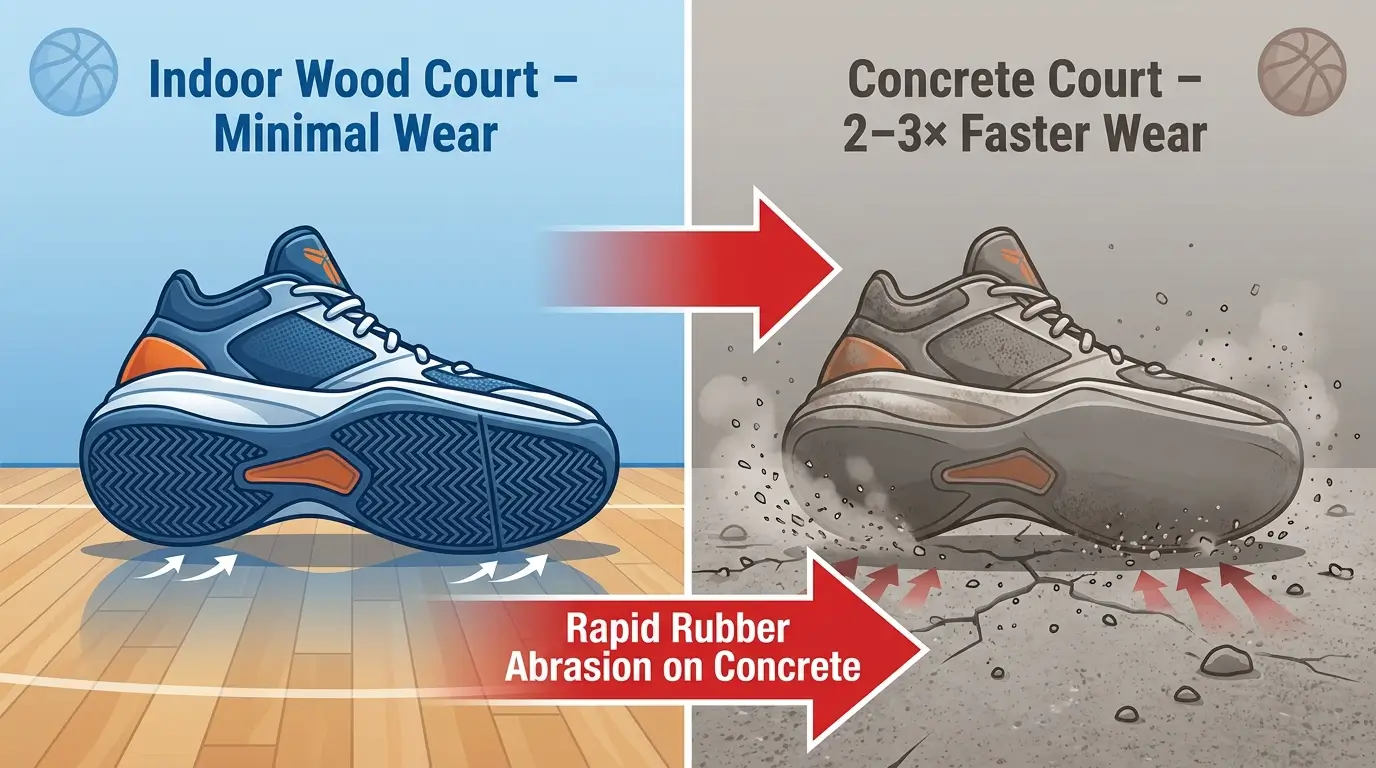
Yes, basketball shoe soles wear out 2–3× faster on concrete than they do on indoor wood courts. Concrete is an inherently rough, abrasive surface that rapidly grinds down soft rubber outsoles. If you are a high-intensity player who cuts hard, drags your toes, or plays outside multiple times a week, you will experience severe basketball shoe sole wear concrete courts are notorious for.
In this guide, we will break down exactly why this rapid degradation happens, how to spot the early warning signs of bottomed-out cushioning, and which outdoor-specific shoes will actually survive your driveway sessions.
Why Concrete Destroys Basketball Shoe Soles Faster
When you take a premium indoor basketball shoe outside, you are effectively taking a sports car off-roading. The materials simply aren’t built for the terrain.
The Science of Rubber Abrasion on Rough Surfaces
To understand outdoor basketball shoe durability, you have to look at friction. Indoor courts are sealed and smooth, allowing soft, tacky rubber to grip the floor without tearing. Concrete is highly porous and jagged at a microscopic level. Every time you pivot or sprint, the concrete acts like 80-grit sandpaper, causing intense rubber outsole abrasion concrete floors naturally produce. The softer the rubber, the faster it peels away.
Concrete vs. Asphalt vs. Indoor Wood: Surface Hardness Comparison
Not all hard courts are created equal. Here is how different surfaces impact your footwear:
Indoor Wood: Smooth and forgiving. Produces almost zero friction-based wear.
Concrete: Hard, unforgiving, and highly abrasive. Rapidly flattens traction patterns.
Asphalt: The most destructive. Asphalt vs concrete shoe wear is a common debate, but asphalt’s jagged, uneven aggregate tears chunks out of rubber faster than smooth concrete slabs.
How Player Style Accelerates Sole Wear
Your biomechanics play a massive role in shoe lifespan. If you are a heavy-footed center, the sheer force of your landings will compress the foam faster. If you are a shifty guard, your lateral crossovers will shred the medial edges of the shoe. This is especially true for players experiencing toe dragging shoe wear outdoor; trailing your foot on a step-back jumper will burn a hole through a soft toe box in a matter of weeks.
How to Tell If Your Basketball Shoes Are Worn Out on Concrete
Playing in dead shoes is a fast track to knee pain and ankle rolls. Do not wait for the shoe to physically fall apart before replacing it.
5 Clear Signs Your Outsole Is Bottomed Out
Bald Spots: The traction pattern (herringbone, spirals) is completely smooth under the ball of your foot or the heel.
Slipping on Dry Days: You lose footing on clean, dry concrete during basic lateral slides.
Visible Midsole: The colored rubber outsole has worn away entirely, exposing the white foam underneath.
Uneven Stance: You experience shoe sole flatness concrete court wear causes, where one side of the shoe rests lower than the other.
Aching Joints: Your knees and lower back ache immediately after a 45-minute outdoor session.
Midsole Creasing & Cushion Breakdown on Hard Courts
Basketball shoe midsole breakdown concrete causes is just as dangerous as rubber loss. The constant high-impact landings on an unforgiving surface compress the EVA or polyurethane foam inside the shoe. According to sports medicine professionals at the American Podiatric Medical Association (APMA), playing high-impact sports in shoes with dead cushioning drastically increases the risk of shin splints, stress fractures, and plantar fasciitis. If the sides of your shoe’s foam have deep, permanent wrinkles, the shock absorption is dead.
When Grip Loss Means It’s Time to Replace
If you are constantly wiping the bottom of your shoes and still sliding out, you are experiencing severe basketball shoe grip loss outdoor. Once the sharp edges of the traction pattern round off, no amount of cleaning will restore the bite. It is time to retire the shoe.
Best Basketball Shoes for Concrete Courts (2026 Update)
Stop wearing your $200 signature indoor shoes on the driveway. You need footwear engineered specifically for hard court footwear durability.
Top 5 Durable Outdoor Basketball Shoes with XDR/Continental Rubber
If you want a shoe to survive the summer, look for specific heavy-duty outsoles.
Nike/Jordan with XDR: Nike produces an “Extra Durable Rubber” (XDR) compound explicitly designed for Asian outdoor markets, which is incredibly tough. You can read more about outdoor-specific tech on Nike’s official footwear innovation pages.
Adidas with Continental Rubber: Continental rubber basketball shoes utilize the same compound found in car tires, offering elite grip and immense lifespan on concrete.
Way of Wade (Fission Series): Renowned for producing some of the thickest, most durable outdoor treads on the market today.
Budget Picks Under $80 That Last on Concrete
You do not need to spend a fortune for outdoor durability. Look for budget models from brands like Under Armour (e.g., the Spawn or Lockdown series) or Puma. Budget shoes often use cheaper, harder rubber compounds, which ironically makes them last much longer on concrete than ultra-premium, soft indoor models.
Shoes to Avoid on Outdoor Courts (Indoor-Only Designs)
Never take shoes with translucent (clear) outsoles outside. They are incredibly soft and will burn off in a few days. Likewise, shoes relying entirely on exposed foam midsoles for traction will be shredded instantly on concrete.
If you’re a toe-dragger who burns through soles fast, check our best shoes for toe draggers durability guide — we tested 23 models for abrasion resistance and toe-cap reinforcement to save you from premature blowouts.
How to Make Your Basketball Shoes Last Longer on Concrete
Even with the toughest rubber, concrete is undefeated. However, you can significantly delay the inevitable with smart equipment management.
Rotate 2+ Pairs to Reduce Daily Abrasion
Foam midsoles need 24 to 48 hours to fully decompress after a heavy session. If you play every day in the same pair, the cushion stays flattened, and the rubber takes double the abuse. Rotating two pairs of outdoor shoes extends the life of both pairs exponentially.
Clean Outsoles After Every Outdoor Session
Concrete dust and tiny pebbles act like micro-abrasives. When they get stuck in your tread, they grind away the rubber with every step you take. Use a stiff nylon brush and a drop of dish soap to scrub the outsoles clean after your weekend games.
Avoid Wearing Court Shoes on Sidewalks/Driveways
Off-court wear kills grip. Do not wear your basketball shoes to walk the dog, go to the grocery store, or drive your car. Put them on when you step onto the court, and take them off the minute you are done playing.
Pair your durable shoes with a ball built for rough surfaces. See our guide on the best outdoor basketball for concrete — it won’t flatten, peel, or lose its grip like an indoor leather ball will on asphalt.
Use Shoe Protectants & Store Properly
Never leave your basketball shoes in the trunk of a hot car. Extreme heat bakes the rubber, causing it to harden, crack, and lose its tacky grip. Keep them indoors in a temperature-controlled environment.
Coach’s Story: The Day I Lost Grip Mid-Game on Concrete
I always preach footwear safety, but I learned this lesson the hard way. Back in 2018, I was playing in a high-stakes local pickup game at a rough concrete park in Chicago. I was wearing a pair of ultra-light indoor guard shoes. They felt great for the first two weeks, but the concrete was silently eating the soft rubber.
Mid-game, I planted my foot hard for a step-back crossover. Instead of gripping, the paper-thin sole completely peeled out from under me. I rolled my ankle violently and spent the next six weeks in a walking boot.
When I inspected the shoe later, the medial traction was entirely bald, and the foam was exposed. That injury cost me my entire summer league. From that day forward, I strictly separated my indoor and outdoor rotations and only bought shoes featuring XDR or Continental rubber for the playground. Relying on verified performance reviews from authoritative testing sites like WearTesters became my go-to strategy before buying any outdoor shoe.
FAQs: Basketball Shoe Sole Wear on Concrete
Q1: How long do basketball shoes last on concrete? For a player hitting the outdoor courts 2–3 times a week, a standard basketball shoe will last about 2 to 3 months on concrete. Shoes built with highly durable outdoor rubber (like XDR) can push that lifespan to 4 to 6 months before bottoming out.
Q2: Are indoor basketball shoes good for concrete? No. Indoor basketball shoes use soft, pliable rubber to grip dust-free hardwood. When used on concrete, this soft rubber is shredded rapidly, ruining the shoe’s traction and cushioning in just a few weeks of aggressive play.
Q3: What rubber lasts longest on concrete courts? Extra Durable Rubber (XDR), Continental rubber, and high-density solid rubber compounds last the longest on concrete. Avoid translucent (clear) rubber outsoles, as they are exceptionally soft and degrade the fastest on abrasive outdoor surfaces.
Q4: Does playing on asphalt wear shoes faster than concrete? Yes, asphalt wears out basketball shoes faster than concrete. Asphalt is composed of crushed rocks and tar, creating a highly jagged, uneven surface that acts like a grater on rubber outsoles, destroying tread patterns faster than a poured concrete slab.
Q5: Can I extend the life of basketball shoes on outdoor courts? Yes. You can extend their life by rotating between two pairs of shoes, brushing concrete dust out of the traction grooves after every game, and strictly reserving the shoes for on-court play only (no casual walking).
Q6: What brand makes the most durable outdoor basketball shoes? Brands like Way of Wade, Adidas (models with Continental rubber), and Nike (models featuring XDR tags) consistently manufacture the most durable outdoor basketball shoes, engineered specifically to withstand intense concrete abrasion.
Final Verdict: Yes, Concrete Wears Soles Faster — But Smart Choices Help
There is no escaping the reality of basketball shoe sole wear concrete courts inflict on your gear. The abrasive surface will always win eventually. However, by understanding the mechanics of rubber abrasion and cushioning breakdown, you can stop throwing your money away on delicate indoor models.
If you play on concrete regularly, you must invest in shoes equipped with XDR, Continental rubber, or thick, solid-tread outsoles. Your knees, your grip on the court, and your wallet will thank you.
Ready to upgrade your outdoor rotation? Check our full best outdoor basketball shoes 2026 guide for coach-tested picks that will actually survive your driveway sessions.
In short: Yes, basketball shoe soles wear out 2–3× faster on concrete due to abrasive roughness. Choose shoes with XDR or continental rubber outsoles, rotate pairs, and clean after every session to maximize lifespan.